
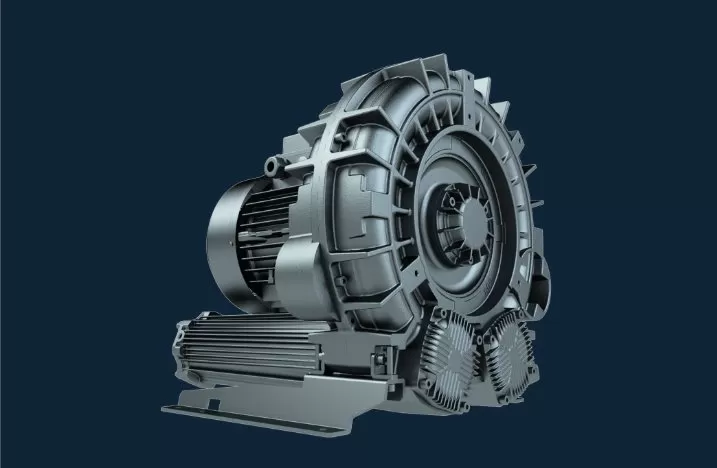
If your tank is shallow, your duty is light and you want almost zero maintenance, a ring blower usually wins. If your tank is deep, your conveying line is long or your plant runs 24×7 at higher pressure, a Roots blower is the safer choice. The rest of this guide explains why, so you can check your own duty before you buy.
How each blower works, in one paragraph
A Roots blower is a positive displacement machine. Two or three lobed rotors trap a fixed pocket of air and push it to the outlet with every turn, so the air volume stays nearly constant even when back pressure rises. A ring blower, also called a side channel or regenerative blower, works differently. A many-bladed impeller on the motor shaft spins air around a ring-shaped channel, adding a little pressure on each pass. It is compact and oil-free, but its air flow drops as pressure rises.
That single difference, constant flow versus falling flow, decides most selections.
Side-by-side comparison
| Factor | Ring blower | Roots blower |
|---|---|---|
| Working principle | Regenerative (dynamic) | Positive displacement |
| Pressure range | Low | Low to medium |
| Flow when pressure rises | Falls noticeably | Stays nearly constant |
| Air quality | Oil-free | Oil-free air path (oil only in gearbox) |
| Drive | Direct on motor shaft | Belt or direct drive with timing gears |
| Maintenance | Very low: bearings and inlet filter | Oil changes, belts, filters, bearings |
| Noise | Quiet, low pulsation | Louder; tri lobe and acoustic hoods reduce it |
| Footprint | Compact | Larger package with base frame and silencers |
| Best for | Small STPs, vacuum, drying, light conveying | Large aeration, deep tanks, pneumatic conveying |
When a ring blower is the better buy
Choose a ring blower when the pressure you need is low and steady, and when nobody on site wants to manage oil and belts. Typical fits:
- Small package STPs and septic tank aeration with shallow tanks and low air demand.
- Aquaculture and fish pond aeration.
- Vacuum hold-down on CNC routers, printing and packaging machines.
- Air knives and drying of bottles, cans and components in food, beverage and dairy plants.
- Dust collection and short-distance light conveying in foundry and engineering units.
Installed correctly, a ring blower can run for years with little attention. Our guide to installing ring blowers: piping and foundations covers the filter, relief valve and piping details that protect it.
When you need a Roots blower
A Roots blower is the right tool when the system pushes back. Because it delivers a fixed volume per turn, it keeps feeding air even as diffusers foul or the tank level rises. Typical fits:
- Aeration in mid-size and large STPs, ETPs and CETPs with deeper tanks.
- Pneumatic conveying of cement, fly ash, sand, grain and powders over longer lines.
- Equalisation tank mixing and filter backwash air scour.
- Continuous 24×7 duty where a standby unit is planned.
Roots blowers come in two designs. Twin lobe blowers are the proven, economical choice for most plants. Tri lobe blowers run with lower pulsation and noise, which suits sites near homes, hospitals and offices. Our Roots vs Twin Lobe vs Tri Lobe guide compares the two in detail.
STP aeration: tank depth is the deciding factor
For sewage treatment plants, the question usually comes down to one number: how deep is the aeration tank? Air has to overcome the water column above the diffusers, plus diffuser and piping losses. Every extra metre of depth adds roughly 0.1 kg/cm² of pressure.
- Shallow tanks with low air demand: a ring blower can do the job at lower cost and with less upkeep.
- Deeper tanks or higher air demand: the ring blower’s flow drops as pressure climbs, so the bacteria get less oxygen than the design assumed. That is when odour complaints start. A Roots blower holds its air flow and keeps the plant within norms.
If you are sizing an STP blower from scratch, start with our step-by-step guide on how to select the right Roots blower for STP aeration, which includes a worked 500 KLD example.
Running cost and maintenance
A ring blower is usually cheaper to buy for small duties and almost free to maintain. A Roots blower costs more upfront and needs oil, belt and filter care, but it is more efficient against higher back pressure and lasts for decades when serviced well.
The mistake to avoid is choosing on purchase price alone. A ring blower pushed beyond its comfortable pressure runs hot and delivers less air. A Roots blower oversized “to be safe” wastes power every hour it runs. For a breakdown of what drives blower cost over its life, see our guide to Roots blower price in India.
Common selection mistakes
- Choosing a ring blower for a deep tank because the brochure flow looks enough at zero pressure.
- Ignoring future diffuser fouling, which raises back pressure over time.
- Skipping the relief valve on a Roots blower, which leads to overheating and motor trips. If that is already happening, read Roots blower overheating: causes and fixes.
- Not planning a standby unit for continuous aeration.
Frequently asked questions
Is a ring blower the same as a Roots blower?
No. A ring blower is a regenerative (side channel) blower. A Roots blower is a positive displacement rotary lobe blower. Twin lobe and tri lobe blowers are both types of Roots blower.
Can a ring blower be used for STP aeration?
Yes, for small STPs with shallow tanks and low air demand. Larger or deeper plants need a Roots blower.
Which is quieter, a ring blower or a Roots blower?
A ring blower is generally quieter. A tri lobe Roots blower with an acoustic hood closes much of the gap.
Does a ring blower need oil?
No. Only its motor bearings need periodic attention.
Not sure which one fits your duty?
Share your air flow, required pressure or tank depth, and duty cycle. Our equipment selection and sizing team will check it and recommend a ring blower or Roots blower, with no overselling. Request a quote or call +91 94870 69937.
Related guides: Roots vs Twin Lobe vs Tri Lobe · Installing Ring Blowers · Roots Blower Overheating: Causes and Fixes