
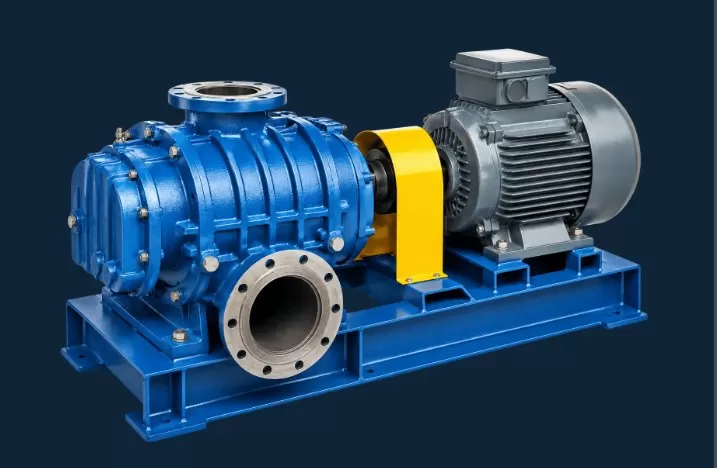
There is no single price for a Roots blower, because no two duties are the same. The price is set by the air flow and pressure you need, the blower design, the motor, and what comes in the package. The bigger cost, though, is the electricity it uses over its life, which is why a correctly sized blower is almost always cheaper than the lowest quote.
This guide explains what drives the price, so you can compare quotes like for like and avoid paying twice.
The 8 factors that set the price
| Factor | How it affects price |
|---|---|
| 1. Air flow (m³/hr or CFM) | Larger flow needs a bigger blower frame and motor |
| 2. Discharge pressure | Higher pressure needs a stronger build and a larger motor |
| 3. Twin lobe or tri lobe | Tri lobe usually costs more but runs quieter with less pulsation |
| 4. Motor size and make | The motor is a large share of package cost; efficiency class matters |
| 5. Drive type | Belt drive, direct drive, or VFD for variable air demand |
| 6. Package accessories | Base frame, silencers, safety valve, non-return valve, gauges, filter |
| 7. Acoustic hood | Adds cost; needed for sites near homes, hospitals and offices |
| 8. Special duty | Vacuum service, gas handling or special materials cost more |
1 and 2. Air flow and pressure
These two numbers decide the blower size more than anything else. In an STP, air flow comes from the oxygen demand of the sewage, and pressure comes mostly from tank depth. Our guide on how to select a Roots blower for STP aeration shows how both are calculated, with a 500 KLD example.
3. Twin lobe or tri lobe
A twin lobe blower is the proven, economical choice for most plants. A tri lobe blower costs more but cuts pulsation and noise, which matters near homes and wards. See Roots vs Twin Lobe vs Tri Lobe for a full comparison.
4 and 5. Motor and drive
A blower runs 24×7 in most plants, so motor efficiency pays back quickly. A VFD adds upfront cost but lets you match air to actual demand, especially when the plant runs below design load for its first years.
6 and 7. What comes in the package
Two quotes can look very different simply because one includes the base frame, inlet filter, silencers, safety valve, non-return valve and pressure gauge, and the other does not. A blower without a safety valve is a false saving: it is the main protection against over-pressure and overheating.
8. Special duty
Gas blowers for biogas and vacuum duties need different seals and construction, which changes the price.
The cost most buyers forget: electricity
The purchase price is a one-time cost. Power is paid every month for 15 years or more.
A simple illustration: a 15 HP blower motor is about 11.2 kW. Running 24 hours a day for a year, that is about 98,000 kWh if the motor draws close to its rating. At an assumed tariff of ₹8 per kWh, that is around ₹7.8 lakh a year in electricity. Over ten years, power can cost many times the price of the blower.
So every 10% of unnecessary motor power costs roughly ₹78,000 a year at that tariff. That is why oversizing “to be safe” is expensive, and why undersizing is worse: the blower runs hot, wears out early and the plant fails pollution control norms.
Why the cheapest quote often costs more
- Undersized blower: runs at its limit, overheats and trips. See Roots blower overheating: causes and fixes.
- Oversized blower: wastes power every hour it runs.
- Missing accessories: silencers, safety valve or filter bought later at extra cost.
- No after-sales support: a cheap blower with no spares or service available becomes an expensive shutdown.
Do you even need a Roots blower?
For small STPs with shallow tanks, vacuum duties or drying, a ring blower may do the job at lower purchase and maintenance cost. For deeper tanks and conveying, a Roots blower is the right choice. Our comparison of Roots blower vs ring blower explains where the line falls.
What to share for an accurate quote
- Air flow required (m³/hr or CFM), or your STP capacity in KLD and BOD load.
- Discharge pressure, or aeration tank depth and pipe length.
- Duty: continuous or intermittent, pressure or vacuum.
- Power supply and whether the blower sits indoors or outdoors.
- Noise limits, especially for apartments, hospitals and hotels.
- Whether you need a standby unit (recommended for any 24×7 aeration).
For sewage treatment plants, tank drawings help us size accurately on the first attempt.
How to compare two quotes fairly
- Check both are quoted at the same air flow and pressure, at site conditions.
- Compare motor HP and efficiency, not just blower model.
- List which accessories each quote includes.
- Ask about delivery time, spares availability and service support.
- Estimate the yearly power cost of each option, not just the purchase price.
Frequently asked questions
What is the price of a Roots blower in India?
It depends on air flow, pressure, motor size, lobe design and accessories. Share your duty point and we will send a quotation.
Is a tri lobe blower more expensive than a twin lobe blower?
Usually yes, but it runs quieter with lower pulsation, which can avoid the cost of extra noise control.
Does a Roots blower price include the motor?
It depends on the quote. A complete package normally includes the motor, base frame, drive, silencers and valves. Always check.
How can I reduce the running cost of my blower?
Size it correctly, use an efficient motor, consider a VFD for variable load, and keep filters and diffusers clean. An AMC keeps it running efficiently.
Get a quote sized to your duty
Send us your air flow and pressure, or your STP capacity and tank depth. We will recommend the right blower, motor and package, with a clear list of what is included. Request a quote, call +91 94870 69937, or download our brochure.
Related guides: How to Select a Roots Blower for STP Aeration · Roots Blower vs Ring Blower · Roots Blower Overheating: Causes and Fixes