
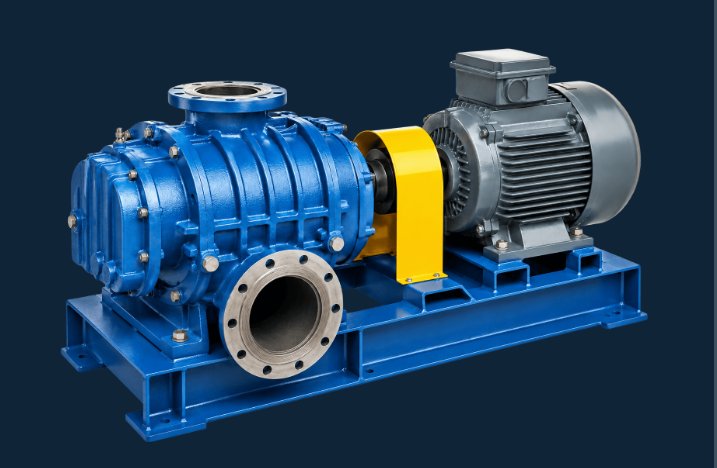
Twin lobe and tri lobe blowers are both Roots-type positive displacement machines, so the name “Roots blower” covers both. The difference is the rotor profile, and that changes pulsation, noise and price.
How a Roots blower moves air
Two rotors turn in opposite directions inside a casing. Air is trapped between the lobes and the casing on the inlet side and carried round to the discharge. There is no compression inside the blower. Pressure builds only because the system downstream resists the flow.
Twin lobe blowers
Each rotor has two lobes. The design is simple, the rotors are easy to machine and spares are easy to find. A twin lobe unit releases air in four pulses per revolution, so discharge pulsation is higher. You hear it as noise and feel it as vibration in light piping.
They suit STP and ETP aeration, pneumatic conveying and general process air, where a silencer and an acoustic hood are acceptable.
Tri lobe blowers
Each rotor has three lobes, giving six smaller pulses per revolution. Flow is smoother, noise is a few dB(A) lower at the same duty and the bearings see less shock loading. The rotors cost more to make, so the blower costs more.
Choose tri lobe when the blower sits near offices or homes, when the pipework is long and light, or when the unit runs at higher pressure for long hours.
Rule of thumb
If noise is not a constraint and pressure stays below about 0.6 kg/cm², a twin lobe blower usually gives the lowest cost per m³ of air.
Side by side
| Parameter | Twin lobe | Tri lobe |
|---|---|---|
| Pulsation | Higher | Lower |
| Noise | Needs a hood at most sites | Quieter at the same duty |
| Capital cost | Lower | Higher |
| Spares | Widely stocked | Readily available |
| Best fit | Aeration, conveying | Noise-sensitive or high-pressure duty |
What we ask before recommending one
- Air flow at site conditions, in m³/hr or CFM
- Discharge pressure, including diffuser and pipe losses
- Running hours per day and whether you need a standby
- Where the blower will sit and any noise limits
- Power supply and whether a VFD is planned
Conclusion
Both designs are reliable when they are sized correctly. Send us your duty point and site details and our team will compare a twin lobe and a tri lobe option, with power figures for each.