
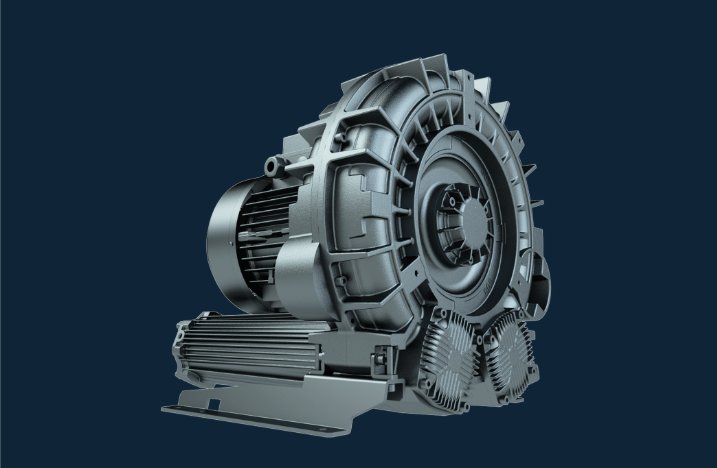
Aeration is the largest energy consumer in a sewage treatment plant. Choosing a blower on air volume alone leads to overload, heat and short bearing life. Here is how we size one against real operating conditions.
1. Start with oxygen demand
Work back from the BOD/COD load to the oxygen requirement, then convert to air flow using diffuser efficiency and submergence depth. Express the result in m³/hr or CFM at site conditions, not at standard conditions.
2. Calculate discharge pressure
Add tank water depth, diffuser head loss, piping and valve losses, and a margin for diffuser fouling. Most STP aeration tanks land between 0.4 and 0.7 kg/cm², which suits Roots and tri-lobe blowers.
Rule of thumb
Size for the hottest day and the dirtiest diffuser, not the commissioning day.
3. Choose the blower type
- Twin-lobe Roots: proven, robust, easy to maintain for continuous duty.
- Tri-lobe: lower pulsation and noise, better efficiency at higher pressures.
- Ring blowers: suited to small tanks and low flow, oil-free.
4. Plan for motor, drive and spares
Select motor HP with at least 10% margin, specify a VFD for load variation, and keep a standby blower on duty rotation. An AMC covering belts, oil, filters and bearings keeps the plant compliant between shutdowns.
5. Worked example: 500 KLD STP
A typical 500 KLD plant with 4 m side water depth needs roughly the following. Treat these as starting points and confirm against your actual BOD load.
| Parameter | Value | Note |
|---|---|---|
| Air flow | ~600 m³/hr | Per duty blower, site conditions |
| Discharge pressure | 0.55 kg/cm² | Includes diffuser fouling margin |
| Motor | 15 HP | With 10% margin and VFD |
| Configuration | 1 duty + 1 standby | Rotate weekly |
Common sizing mistakes
- Using standard-condition air flow instead of site temperature and altitude.
- Ignoring pressure drop in long headers, silencers and non-return valves.
- Oversizing the motor, then running at low load with poor efficiency.
- No standby unit, so maintenance forces a plant shutdown.
Frequently asked questions
Roots or tri-lobe for aeration?
Roots suits most STPs on cost and serviceability. Choose tri-lobe where noise, pulsation or energy cost matter most.
How often should a blower be serviced?
Check oil and belts monthly, change filters every quarter and inspect bearings annually. An AMC schedules all of this.
Can Sigma size the blower for me?
Yes. Send your flow, pressure and tank details through the form and our engineers will recommend a model.
Conclusion
A correctly sized blower runs cooler, uses less power and lasts longer. Start from oxygen demand, calculate real discharge pressure, then choose the type, drive and spares to match. If you would like a second opinion, our team reviews applications free of charge.