
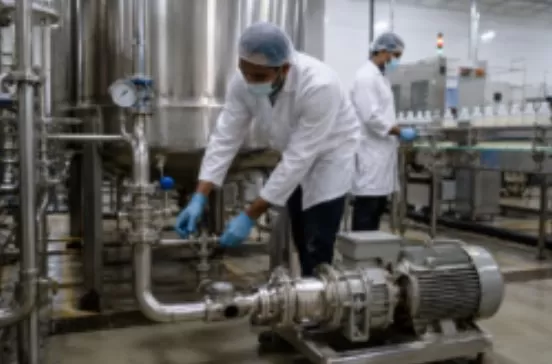
For most industrial and commercial RO plants, the high-pressure pump is a stainless steel multistage pump, sized from two numbers: the feed flow your membranes need and the pressure they need to work. The material is chosen by how salty and how hot the water is. Get those three right and the pump protects your membranes instead of damaging them.
The pumps in an RO system
An RO plant uses more than one pump. Each has a different job.
| Pump | Job | Typical type |
|---|---|---|
| Raw water feed | Lifts water from the tank to the pre-treatment | Centrifugal or horizontal multistage |
| Filter feed | Pushes water through sand and carbon filters | Centrifugal or multistage |
| High-pressure (HP) pump | Drives water through the RO membranes | Vertical or horizontal multistage |
| Permeate transfer | Moves product water to storage or use | Centrifugal or multistage |
| Reject handling | Moves reject to the next stage or evaporator (in ZLD) | Multistage |
| CIP pump | Circulates cleaning chemicals through membranes | Stainless centrifugal |
The high-pressure pump is the most critical and the biggest power user, so most of this guide focuses on it.
Why multistage pumps suit RO
RO membranes need high pressure at a fairly modest flow. A single-impeller centrifugal pump cannot build that pressure efficiently. A multistage pump stacks several impellers on one shaft, adding pressure stage by stage, so one compact pump reaches the pressure the membranes need. Our guide on multistage vs centrifugal pumps explains the difference in more detail.
Step 1: Work out the feed flow
Your RO system is designed for a certain permeate (product water) output and a recovery rate. Recovery is the share of feed water that becomes permeate.
Feed flow = permeate flow ÷ recovery
Step 2: Work out the pressure
The HP pump must deliver the membrane feed pressure your RO designer specifies, plus losses in the piping, cartridge filter and valves between the pump and the membranes. Required pressure rises with feed water TDS: brackish water needs far less than high-TDS effluent or reject being concentrated in a ZLD plant.
Use the membrane design software output or your RO supplier’s datasheet for this number, and size for the worst case: the end of membrane life, at the lowest water temperature, when pressure demand is highest.
Worked example
Illustrative figures only. Use your RO design for real selection.
| Parameter | Value | Note |
|---|---|---|
| Permeate required | 10 m³/hr | Plant design |
| Recovery | 75% | From RO design |
| Feed flow | about 13.3 m³/hr | 10 ÷ 0.75 |
| Membrane feed pressure | 14 bar | From RO design, worst case |
| Losses after the pump | about 1 bar | Piping, valves, cartridge filter |
| HP pump duty point | about 13.3 m³/hr at 15 bar | Checked on the pump curve |
The model and number of stages are then chosen so this duty point sits close to the pump’s best efficiency point. That matters because the HP pump runs for thousands of hours a year.
Step 3: Choose the material of construction
The wetted parts must resist the water they handle.
- SS 304: clean, low-chloride water.
- SS 316: higher chlorides, treated effluent, most industrial RO.
- Duplex or higher grades: very high chloride and saline duties, such as concentrated reject.
Temperature matters too: hot feed water needs a seal and elastomer rated for it. In textile dyeing ZLD plants, where effluent is hot and saline, this choice decides how long the pump lasts. See our page on textile dyeing, ETP and ZLD for the full equipment chain.
Vertical or horizontal multistage?
- Vertical multistage pump: small footprint, in-line suction and discharge, easy to fit into a skid. The usual choice for small and medium RO plants.
- Horizontal multistage pump: easier to service at higher flows and often preferred for larger duties and reject transfer.
We choose based on flow, pressure and plant layout.
Protect the membranes and the pump
A badly controlled HP pump can damage membranes worth more than the pump itself.
- Soft start or VFD: a sudden pressure surge at start-up can damage membranes. A variable frequency drive ramps up gently and lets you raise pressure as membranes age, instead of throttling a valve.
- Low-pressure switch on suction: stops the pump if feed water runs short, preventing dry running, which destroys mechanical seals quickly.
- High-pressure switch on discharge: trips the pump if pressure goes above the membrane limit.
- Check valve and pressure gauges on both sides of the pump.
Seal failures on RO pumps usually trace back to dry running or a wrong seal material. Our guide on common causes of pump seal failure covers the warning signs.
Where else this applies
The same selection logic works for RO and process water in food, beverage and dairy plants, treated water reuse after an STP, and boiler feed. If your RO plant sits downstream of an STP or ETP, the raw effluent and sludge side is a different job: see our guide on choosing a submersible sewage pump.
Frequently asked questions
Which pump is best for an RO plant?
A stainless steel multistage pump is the most common choice for RO high-pressure feed, sized to your membrane pressure and recovery.
SS 304 or SS 316 for an RO pump?
SS 304 for clean, low-chloride water. SS 316 or higher for treated effluent, higher chlorides or saline water.
Why is my RO pump giving low pressure?
Common causes are worn impellers, air in the suction, a partly closed valve, a choked cartridge filter upstream, or wrong motor rotation.
Do I need a VFD on my RO high-pressure pump?
It is strongly recommended. A VFD gives a soft start that protects membranes and saves energy compared with throttling.
Get your RO pump sized correctly
Send us your permeate flow, recovery, membrane pressure, feed water TDS and temperature. Our selection and sizing team will recommend the model, stages and material, and our commissioning team will set it up against its duty point. Request a quote or call +91 94870 69937.
Related guides: Multistage vs Centrifugal Pumps · Common Causes of Pump Seal Failure · How to Choose a Submersible Sewage Pump